Showing posts with label retro. Show all posts

20 March 2012

30 Mid-Century Travel Ads to Spark Retro Wanderlust

First, a Public Service Announcement: LAST CHANCE to enter the Galley Giveaway / Pimp My Postcard contest! (Original deadline was this Thursday, but I'll probably accept anything I get through the weekend.)
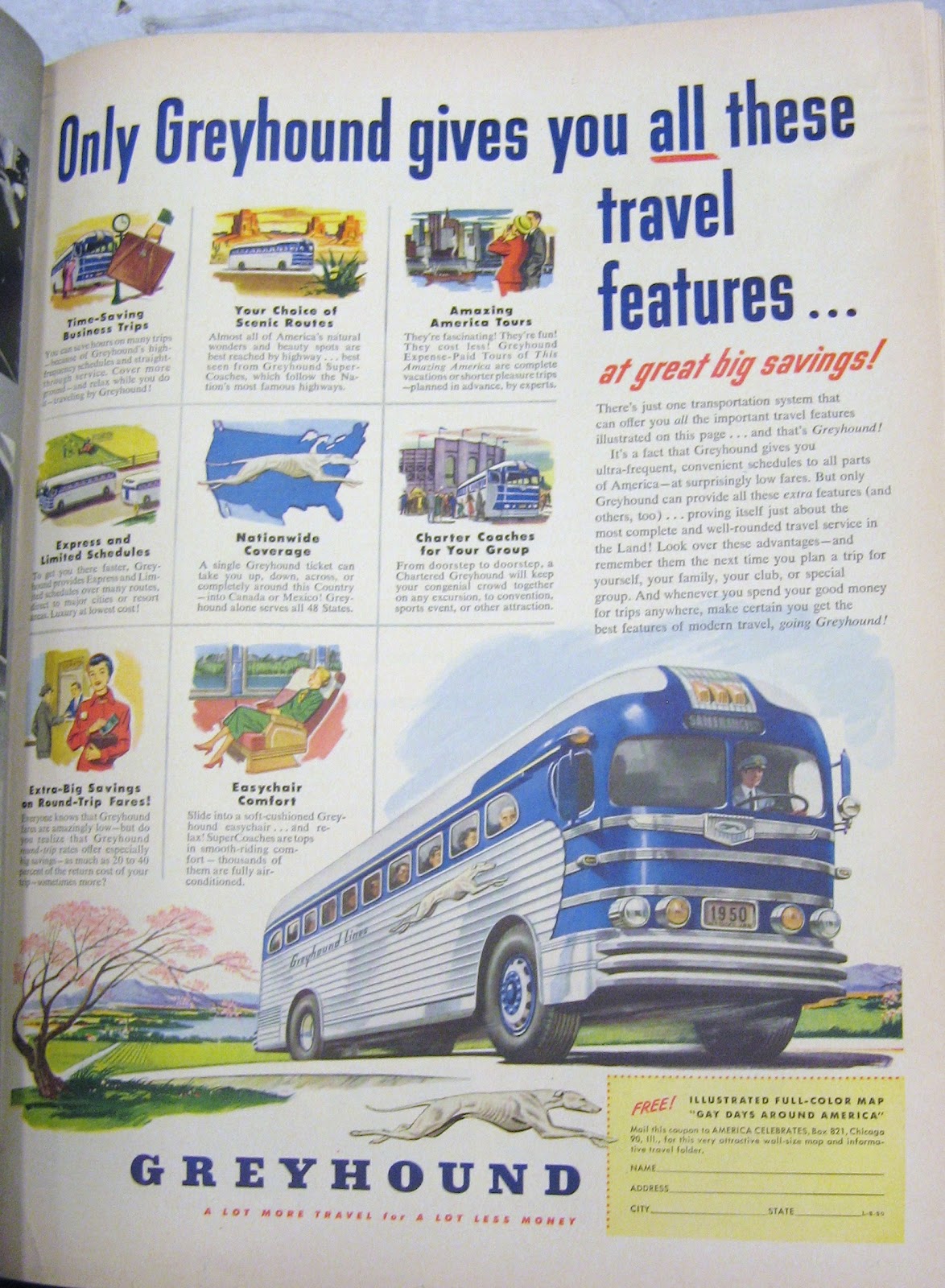
 And now I present to you ... thirty old-fashioned travel ads from Life magazine in the 1940s, '50s, and '60s. I found these when I was at the library researching my retro-European-travel-and-stuff book (cough-ahem, comes out April 3rd). They're in chronological order, starting with the 1940s. Most are for specific destinations or ways to get there (e.g. airlines), but I've also included some for travel accessories or that offer some sort of insight into how Americans thought about travel in a given year--like the Chef Boy-Ar-Dee ads that claim popping open a can of spaghetti is "Almost like being in a cafe in Rome." 

Note how the mode of transportation and the specific places being advertised evolves over the years. The earliest ones, with one notable exception, are all about seeing the USA by road or rail. Later on, they're about package tours to Europe. And at the very end, in the 1960s, the ads emphasize independent travel to Europe. Okay, enough set-up. You're just here for the ads. 

1.


1946


2.

1946. Close-up of text below. Basically, this ad was invited US service men and women 
who fought in Europe to come back as tourists.

Close-up of the above ad. Apologies for the low quality of the image.


3.

1946


4.

1947


5.

1947


6.

1948


7.

1948


8.

1950


[many more after the jump]

27 July 2010

Chef Boyardee and the meaning of authentic cuisine

One evening in Florence, I had some bold journalistic investigations to undertake. I needed to eat pizza.

Before we go on, please take a good look at these Life magazine ads from 1956:

"Your first taste of Chef Boy-Ar-Dee Ravioli lets you know this is the true Italian dish."

"That's the way they serve pizza in Amalfi!"

In 1944, a New York Times article about a just-opened pizzeria led with this description of the exotic foodstuff: “One of the most popular dishes in southern Italy, especially in the vicinity of Naples, is pizza—a pie made from a yeast dough and filled with any number of different centers, each one containing tomatoes. Cheese, mushrooms, anchovies, capers, onions and so on may be used.” Gosh, sounds appetizing, doesn’t it?

Twenty years after that rather detached, straightforward description appeared, pizza was so commonplace that in the menu phrasebook section of Europe on Five Dollars a Day, Arthur Frommer offers not a translation but a wiseacre wink: “You know this one.”

Now, another fifty years on, I settled myself into a corner table at one of Arthur’s recommended restaurants—he claimed, “no surprises; no cover,” but surprise, Arthur, there was a two-euro cover—and ordered my own “pie made from a yeast dough” to see how it measured up. It was good enough, with the crust slightly charred from the wood-fired oven and the slight saltiness of the prosciutto perfectly balancing with the creamy mozzarella and the earthy depth of the funghi.

But here’s what struck me: it wasn’t as good—or as authentic—as the pizza I can get at either of two different restaurants in my neighborhood back home in Minneapolis. With their imported San Marzano tomatoes, artisanal toppings, mozzarella di bufala, and sea salt-dusted crusts, these are marketed as paragons of the authentic Italian cuisine. One restaurant is a member of Vera Pizza Napoletana, the official and famously strict arbiter of true Neapolitan pizza. Even the decor and menu design of those pizzerias back home are superficially more authentic, more Old World Italian than the restaurants I visited in Florence.

Today, some of Arthur’s and my mother’s comments about Italian foods seem nearly as naive and wide-eyed as that 1944 Times article. Arthur lists fettuccine and risotto in the vegetable section, for example; most Americans today would probably not just recategorize them but smirk at the accurate-but-not-entirely translations of these as “noodles” and “rice,” of gelato as merely “ice cream,” and of prosciutto as simply “ham.” Mom explained the concept of a trattoria to my father in one of her letters and waxed rhapsodic about a particularly exotic dish that I immediately recognized, having seen it on multiple restaurant menus back home, as saltimbocca.

Though Arthur and my mother undoubtedly had their own preconceptions of Europe, based on photographs, books, and previous tourists’ tales, the information available to them before their trips was paltry compared to what today’s information-overloaded travelers have at their disposal. Mom didn’t have a hundred different guidebooks and a thousand different web sites telling her what to expect. Italian food hadn’t become so commonplace as to be cliché, as evidenced by Wendy’s recent short-lived line of sandwiches marketed under the Italian-by-way-of-focus-group name Frescata or, most of all, Fancy Feast's gourmet cat foods, which include both Florentine and Tuscany lines, apparently intended for the sophisticated, citizen-of-the-world felines: “Romance your cat's taste buds with Fancy Feast Tuscany wet cat food recipes. Tuscany recipes are accented with long grain rice and garden greens.”

The fact is, in any given urban area in the United States today, you can easily find food that is more authentically Italian than that found in most cafes in tourist areas of Italy. That wasn’t at all true in 1960s America, where “Italian” basically meant cheap wine and gummy spaghetti, or the previously-mentioned Chef Boyardee. Most travelers of that era likely had not experienced even the watered-down, theme park version of Italian cuisine presented, today, by the likes of Buca di Beppo and The Olive Garden. Their expectations of Italian cuisine in Italy—of Italian culture in general—were not the same, not as high, as modern tourists'. Mom and Frommer and their peers couldn’t presume to believe they knew exactly what to expect, which was probably for the better. They didn't expect their pizza to taste a certain way; they weren't measuring the tourist cafe against the better Italian food back home.


Put another way--and this applies to more than just food--back then they were ignorant; today we’re delusional. 

One more 1956 Chef Boyardee ad for you: 

"Chef is the one spaghetti this side of the ocean that makes a special point of following old-country traditions."

23 July 2010

Quote of the day: the cure for loneliness on the road

"And what if I became manic-depressive through an acute sense of isolation? Oh well, I comforted myself, I have resources: I talk to myself."

-- Rochelle Girson, Maiden Voyages: A Lively Guide for the Woman Traveler (1954)
 

20 July 2010

A single moment of air traffic: 1956 vs. 2010

Air traffic over the Atlantic at a single moment in 1956 (4:00 a.m. GMT, May 6).


[Accompanying text reprinted at the end of this post.]

I couldn't a comparable recent graphic, but I did find this 2008 video showing all global air traffic in a single day. (So for a direct comparison, you could pause the video to generate a "single moment"; I believe 4 a.m. GMT would be right at the start, actually.)


And here's all the air traffic over the U.S. (and slightly beyond) at about 4:30 a.m. GMT on July 18, 2010.


The top image is from Life magazine, June 18, 1956. The text below the graphic says:


The extraordinary future of international air travel is best foretold in the busy pattern of the present. The map above shows air activity during a single actual moment in the air over the Atlantic--a quiet moment, darkened by night. it is 4 a.m. on May 6, 1956 in London, 11 p.m. of the evening before across the ocean in New York. But though the scene is far from human habitation, the air is filled with the roar of big planes, and with the disembodied voices of pilots, radio operators and traffic controllers exchanging information.


There are 110 planes engaged at this moment in flying over the ocean. Of them 39 are military aircraft on regular training missions or engaged in carrying personnel and cargo to and from overseas bases. One is an oil company plane headed from New York to Amsterdam. The remaining 70 are transport planes belonging to 18 airlines engaged in flying passengers and cargo regularly across the Atlantic. Aboard them are 3,295 passengers and crew. 


Two facts about the chart show how much of the air age is an American achievement. Every plane shown here was made in the U.S.--by Douglas, Lockheed, Boeing. And U.S. airlines are operate almost as many of the commercial planes (34) as as carriers from all other nations put together. 


These lanes over the Atlantic are the busiest in the international air. But at this moment other lines operating out of the U.S. and Europe are sending planes on around the globe in opposite directions to meet in distant places and bind the world in a careful meeting of flight schedules. 

15 July 2010

The things we no longer carry (portable record player, anyone?)

Temple Fielding wrote the guidebook that Arthur Frommer loved to mock, Fielding's Travel Guide to Europe. "It maps out ... the short, quick road to insolvency that most American tourists have been traveling for years," Arthur wrote.

In 1968, eleven years after the first edition of Europe on Five Dollars a Day--and a year after my mother toured the continent with that same budget-oriented guidebook--John McPhee profiled Temple Fielding in The New Yorker. After Fielding's first book came out in 1946, McPhee, writes, he "was soon operating virtually without competition as councellor to the millions of American tourists who have traversed Europe in the postwar years, and his closest competitors became, as they have remained, scarcely visible behind him."

I don't have numbers to back me up, but I strongly suspect that this is a case of The New Yorker's stereotypically myopic, upper crust worldview getting the best of it, this being the magazine that was, famously, “not edited for the old lady in Dubuque.”  There's only a cursory mention of E5D and Arthur Frommer in the profile, in this dismissal: "Fielding does not think much of Arthur Frommer's Europe on Five Dollars a Day. 'We don't respect Frommer,' he told me in an even, sad voice." But even though neither McPhee nor Fielding get any deeper into the subject, E5D was gaining ground rapidly was already a cultural touchstone by this point; it's telling that Fielding came out with his own Super-Economy Guide to Europe in 1967.  E5D already was the go-to book for the younger, more frugal set (like my mother). The first run of the original edition of the book was 5,000, and according to Arthur, "it no sooner reached the bookstores than it absolutely disappeared." In Mom's letters, she mentioned Fodor's guidebook and Europe on Five Dollars a Day. Not a word about Fielding's.

The most telling difference between Fielding and Frommer, to my mind, is not in the places they recommend staying or eating (although the contrasts there are indeed profound) but in how they packed, the things they carried:

Temple Fielding's packing list (from McPhee's profile):
The [large raffia] basket and its standard contents go with fielding around Western Europe on all his annual trips, which ordinarily last for five interrupted months. In it Fielding keeps a bottle of maraschino cherries, a bottle of Angostura biters, a portable Philips three-speed record-player, five records (four of mood music and "one Sinatra always"), a leather-covered RCA transistor radio, an old half-pint Heublein bottle full of vermouth, and a large nickel thermos with a wide mouth.  
... Fielding also carries a large calfskin briefcase that was designed by him (it is full of compartments) and was made by Loewe, a Spanish purveyor of stunningly fine leather goods. The forty-one items inside the briefcase are standard on all his travels. [These include] his sterling-silver paper stapler (by Tiffany), his plastic fork, his plastic spoon, his stud box, his dwarf American cigars, his standard toothbrush, his collapsible toothbrush, his rubber bands, his paper clips, his eraser, his credit cards, his peanuts, his two-inch bottles of Johnnie Walker ... his Fernet-Branca ... his working notebook ... his ink, his Scotch Tape, his ballpoint-pen refills, his undercover notebook for surreptitious notes ... his alarm wristwatch, his Buech-Girod alarm clock ("It's the world's smallest; it yodels") ... 
Fielding uses two suitcases, and in them he packs thirty-five handkerchiefs (all of hand-rolled Swiss linen and all bearing his signature, hand-embroidered), ten shirts, ten ties, ten pairs of undershorts, three pairs of silk pajamas, eight pairs of socks, evening clothes, three pairs of shoes, a lounging robe, a pair of sealskin slippers, and two toilet kits. ... He wears one suit and carries two. 
Okay, this list goes on. There's also a spinning top. And a mink-covered beer-can opener. You get the idea--the idea being that, goodness, (a) that's way too much, and (b), that sounds like the packing list of a Bond villain. Five bucks says Fielding knew how to use each of those items as a lethal weapon.

And here's Arthur, or rather, his wife, Hope, who wrote the "Packing to Save Money" chapter:
The tourist who carries heavy luggage and a complete wardrobe to Europe spends a great deal of money unnecessarily. ... A light suitcase means freedom. ... If you make the right decision, you'll do the following when it comes time to pack. You'll first buy the lightest suitcase available. You'll then fill it with the skimpiest set of clothing your courage will allow. Having done that, you'll then remove half these clothes from the suitcase, and depart on your Europe trip. 

For men, this is Hope's packing recommended packing list:

3 pairs of shorts (dacron or nylon)
3 cotton T-shirts
3 pairs of socks (at least one pair should be nylon)
2 handkerchiefs [recall that Fielding packed 35]
1 sweater
2 Wash 'n Wear Drip-Dry sport shirts
1 Drip-Dry white dress shirt
1 pair dress shoes
1 pair canvas shoes
1 light bathrobe
2 pair of nylon or dacron pajamas
1 tweed sports jacket
1 pair of heavy slacks
1 pair of chino slacks
1 summer suit
1 raincoat 
2 neckties
1 bathing suit
toilet and shaving articles (adapted for European use, if electric)

Don't take another thing!
Of course, to the modern reader, this still seems like an absurdly long list. Two suits? A bathrobe? Even if you take care to be a bit more formal than the average tourist, you're still probably packing fewer garments and of lighter material.

One final, amusing thing to note: Hope also suggests that you "roll into scroll-like shapes whatever is rollable: underwear, slips, bras, and so forth--all the things that don't have to be wrinkle-free. In that manner, these items can be placed along the sides of your suitcase easily, or into the most unusual cracks and crevices (you'll discover plenty of them while packing)."

Does that sound at all familiar? If you travel at all or read any travel-related web sites or publications, you've probably heard this before, always presented as a modern innovation. A mere two months ago, the New York Times breathlessly reported that "many flight attendants roll their clothes rather than fold them to save space."

Yeah, well. E5D got there first. Again.

For more on packing, innovative or otherwise, check out these past posts:


What's in my backpack?
The burdens of baggage