Showing posts with label research. Show all posts

20 March 2012

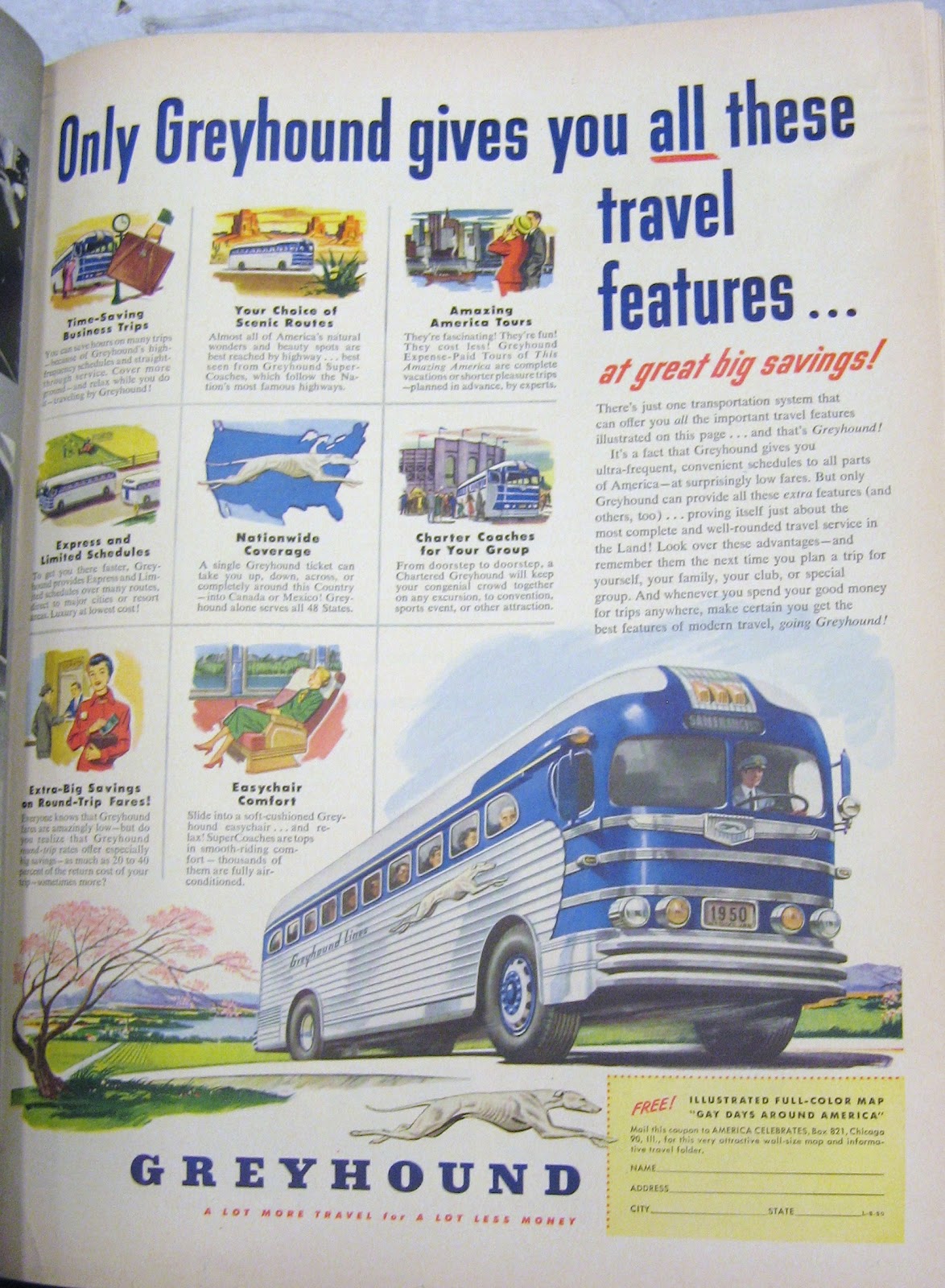
30 Mid-Century Travel Ads to Spark Retro Wanderlust

First, a Public Service Announcement: LAST CHANCE to enter the Galley Giveaway / Pimp My Postcard contest! (Original deadline was this Thursday, but I'll probably accept anything I get through the weekend.)
 And now I present to you ... thirty old-fashioned travel ads from Life magazine in the 1940s, '50s, and '60s. I found these when I was at the library researching my retro-European-travel-and-stuff book (cough-ahem, comes out April 3rd). They're in chronological order, starting with the 1940s. Most are for specific destinations or ways to get there (e.g. airlines), but I've also included some for travel accessories or that offer some sort of insight into how Americans thought about travel in a given year--like the Chef Boy-Ar-Dee ads that claim popping open a can of spaghetti is "Almost like being in a cafe in Rome." 

Note how the mode of transportation and the specific places being advertised evolves over the years. The earliest ones, with one notable exception, are all about seeing the USA by road or rail. Later on, they're about package tours to Europe. And at the very end, in the 1960s, the ads emphasize independent travel to Europe. Okay, enough set-up. You're just here for the ads. 

1.


1946


2.

1946. Close-up of text below. Basically, this ad was invited US service men and women 
who fought in Europe to come back as tourists.

Close-up of the above ad. Apologies for the low quality of the image.


3.

1946


4.

1947


5.

1947


6.

1948


7.

1948


8.

1950


[many more after the jump]

21 September 2010

Do guidebooks create the beaten path?

I have a recent edition of Rick Steves Europe Through the Back Door. Here's what it says on the back cover: “Avoid crowds and tourist traps . . . Discover off-the-beaten-path towns, trails, and natural wonders.”

But as anyone who has followed the insider knowledge of such guidebooks can attest, by the time you get to one of these hidden gems, you'll find a dozen other tourists already there, each one bearing your same guidebook and the glum expression that says, "This is not what I was promised."

You know that famous Yogi Berra line, "No one goes there; it's too crowded"? With guidebooks, we get just the opposite phenomenon: everyone goes there because it's not crowded.

This is nothing new. A 1963 profile of Arthur Frommer in Time included the following anecdote:
Last week in Paris one proud hotelier told Frommer: "It is your book which bought this elevator." But the new lift meant higher rentals, and Frommer sadly made a note to drop the hotel from the next edition. 
Or there's this, from the 1966 edition of Let's Go: The Student Guide to Europe (and which serves as a reminder that the snarkiness of youth is timeless):
In the low-cost field the most popular guide is Frommer's Europe on $5 a Day, which has become so widely circulated among American tourists that you will generally find them sitting on top of each other in the hotels and restaurants recommended.
The most telling example of a guidebook's impact on a place is, I think, one that involves Frommer's rival Temple Fielding, he of the raffia basket carry-on and the portable record players and the mink-covered beer can opener. Such was the impact of his guidebook that, according to John McPhee's 1968 New Yorker profile, "A waiter's strike in Italy was postponed when leaders of the national waters' union were informed that Fielding was in the country."

The guidebook effect extends way off the beaten path, too. In Getting Stoned With Savages, J. Maarten Troost travels to the South Pacific island of Malekula, where he meets a man while walking through the forest:
"I am George," he said curtly. "Do you have a Lonely Planet?"
I did indeed have a Lonely Planet guide to Vanuatu. We had brought it out from the U.S. Remarkably, they had a chapter on Malekula, which I had read thoroughly, highlighting all the references--and there were many--to the dangers posed by sharks.
"Turn to page one-fourteen," he said. "Do you see?" He jabbed at the page. "That's me."
The entry to which he referred read, in its entirety: "In the village on Wala Island, George's Guestroom  is small, for one or two people."
And have you read Eat, Pray, Love? Don't lie. You're reading a travel blog. I'm just going to guess, then, that you've either read or intentionally avoided Elizabeth Gilbert's gazillion-copy-selling spiritual self-help tract masquerading as travel writing. Just a hunch.

Anyway. So she goes to Bali. To (proper-noun) Love. But she's not quite done with the praying and the physical health stuff, either. Gilbert befriends a healer named Wayan, and decides to help her out--in part so that Wayan can reach that eternal goal of the tourist-area business owner: a listing in a prominent guidebook.
If she had a home, she could finally be listed in Lonely Planet, who keep wanting to mention her services, but never can do so, because she never has a permanent address that they can print. 
As it turns out, Lonely Planet was not the book that really put Wayan on the tourist trail. That, of course, fell to . . . Eat, Pray, Love.  From Time last month:
Wayan, an outspoken Indonesian healer of dark beauty and another of Eat, Pray, Love's personalities, was, with her young daughter and two adopted orphans, once on the verge of eviction. Now a staff of well-built men churns out her healthful Vitamin Lunches for calling travelers. From January to March of 2006, 237,260 foreign tourists stopped by Bali. Since then the number has swelled steadily, and in the same three months of this year, there were 551,186 visitors to the island.
While precise figures are not yet available, industry observers from the Denpasar Tourism Academy have confirmed that the island has been repopulated by tourists looking to develop their spirituality. . . . "It's a thing we want to promote because those activities bring peace to mind," says Nyoman Suwidjana, deputy chairman of the Bali Tourism Board. "And Bali loves peace."
Emphasis mine. Just in case you missed the irony. 

03 May 2010

Reading list: crunching the numbers

Hey, the US Office of Travel & Tourism Industries just released the outbound tourism figures for 2009! Are you as excited about this and totally pumped up to start analyzing the numbers as I am??

No? Huh. Well, your loss.

The key figure is -4 percent--that's the change in travel from the US to Europe from 2008 to 2009. No surprise there, given the state of the economy. Total amount of US citizen air traffic to Europe was precisely 11,929,977 (note that this is the number of airplane trips, so if you flew to Europe two times, you count twice; if you went by boat, you count not at all, and ditto if you're not a passport-wielding citizen).

In other news, I recently finished reading Pico Iyer's The Global Soul, about which I'll offer a full review sometime soon. Short version: being born in Culture A, raised in Culture B, and now living in Culture C makes it difficult to feel at ease. Also, globalization creates a cultural dissonance-slash-fusion that is at once beguiling and bewildering. Obvious, self-evident? Okay, sure, maybe. But Iyer's commentary seems awfully prescient and impressive considering that it dates to 2000, before Facebook and Twitter and YouTube and much of the internet as we know it transformed how we communicate and how we both create and consume culture.

Next on the reading list (forgive the non-MLA-approved citation methodology below):

  • Worldwatch Institute Paper 159: Traveling Light: New Paths for International Tourism (Lisa Mastny, Ed.; 2001)
  • What is the Impact of Tourism? (Roman Espejo, Ed.; 2009)
  • The Travel Industry (Gee, Makens, and Choy; 1989)


... and two that I read a long time ago but need to revisit:

  • The Tourist: A New Theory of the Leisure Class (Dean MacCannell; 1976)
  • Tourism in History: From Imperial Rome to the Present (Maxine Feifer; 1985)

Note the dates on those sources: most are at least twenty years old, the exceptions being the two shortest and most esoteric ones. Most of the other books I've found about tourism (e.g. Paul Fussell's Abroad) were also published somewhere between 1970 and 1990. I find this most curious because, if anything, the subject has gotten only more complex and interesting with the rise of eco-tourism, grief tourism, and heritage tourism (etc.), plus the indescribably immense impact of the internet on our ability to plan our trips and keep in touch while we're abroad. Seems like now would be a great time for another influx of tourism-examining books. So where are they? (That's a serious question, by the way, not just an excuse for me to say, "Gosh, maybe I'll just have to write such a book myself! Oh, wait, I'm already doing that! Look at me being all timely and zeitgeisty!" Honestly: Where are the real books by the real journalists?)

Any suggestions for tourism-related books I should read? Especially newer ones that I may have missed? Let me know! Comment below or e-mail me at doug@douglasmack.net.