28 February 2012

Advance copy giveaway: send me your coolest postcard

Pimp my postcard! Artify my aerogram! (I'm a writer, I can make words up.) Announcing the Europe on Five Wrong Turns a Day Galley-Giveaway Contest. (E5WTDGGC.) 

UPDATE: I'll accept postcards I get through the weekend. Just 'cause I'm nice. If I get it by Monday, March 26th, you're in. 

Send me the coolest postcard or letter you can dream up. The most awesome one, as judged by yours truly, will win this priceless item:


Why's it valuable?

  1. It's a highly entertaining and slyly informative travel memoir that will surely make you a better person just by holding it. Sweet! 
  2. It's a special, limited-edition galley (advance copy), with a sprinkling of special, limited-edition typos that don't appear in the final edition of the book--errors that surely make this advance copy all the more valuable, like those stamps with the upside-down airplane. Added bonus:It gives you blackmail material against me, if you can find that one really embarrassing typo. Awesome!
  3. I'll send it to you before the official copies go on sale. Bragging rights! 
  4. I'll sign it just for you, and mail it with my very own hands. ¡Excelente!
  5. It was in said hands when I high-fived Mary Tyler Moore. 
Holla!
But wait! Yeah. There's more. The winner will also get a handful of Commentary Track Bookmarks (there are some examples over on the book web site), so that you'll not only see my typos but get some behind-the-scenes comments and notes. You'll have greater insight into the book than anyone else. Even Mary Tyler Moore. 

So what's the contest?
Simple: send me the craziest, coolest, most intriguing postcard or aerogram I've ever seen. Maybe it's cool because it tells an amazing story. Maybe it's covered in drawings or it's folded into aero-origami. Be creative. The winner is the one that I deem the most awesome. 

Pimp my postcard, artify my aerogram, put something cool in my mailbox. Kind of like this, except I know you can do about a thousand times better:


Rules: 
  1. Letters/postcards/aerograms only. No packages, please.
  2. Send it to:
    Doug Mack
    PO Box 1922
    Minneapolis, MN (USA)
    55458-1922
  3. I must receive it by March 22, 2012. That gives you three weeks. Go.
  4. You can find an aerogram template here. Or, if that doesn't work for some reason, here's another one.
  5. Include some kind of contact info so that I can reach you if you win. I'll blur it if I post the postcard/aerogram on the blog.
  6. I'll send the book anywhere in the world, so if you're in another country and can get me a postcard/aerogram by the above date, go for it. 
  7. I reserve the right to post images of any and all entries on my blog. By entering the contest, you agree that I may do so. (The copyright is still yours, and I won't license or sell the image for profit or anything like that; you're just granting me the right to post the letter/postcard/aerogram on my blog.)
  8. Be awesome.
Questions? 

27 February 2012

The Benefits of Getting Hustled in Havana


Maren and I arrived in Havana and promptly got scammed. At the airport, we'd agreed on a price with our taxi driver, but when we got to our casa particular in Old Havana, he gave us the cold-eyed smirk of a movie villain and told us that the cost was per person. It was late, we were tired and vastly out of our element and, if I'm to be honest, just a little bit scared. We sighed and handed over the money. 

We spent the next few days doing the tourist things—museums; parks; a lot of happily aimless wandering through the narrow streets of Old Havana—our spirits on a constant upward trend from that inauspicious beginning. But we were always on guard because the hustlers were everywhere, offering everything: Hola amigo, you want a cigar? Rum? Taxi? Tour? Tell me what do you need amigo--I'll get it for you. We quickly mastered the art of smile-nod-walk-away-quickly. We didn't want to get burned again. 

* * *

Now it's our last night, and we're ready to give in to the hustle. We've come to understand that the hustlers are, in fact, the best way to acquire certain things. Like a paladar—essentially, a semi-official restaurant in someone's home; often it's literally just a card table or two in a family kitchen. There's no sign on the street; most don't show up in any guidebooks. You just have to wait for someone to step from the shadows. Hola amigo, you need a paladar?

But, of course, the second you go looking for a hustler, there are none to be found. We spend a good hour traipsing through the streets where we were previously hounded, back when we were still skittish. We get eager every time a local so much as makes eye contact with us. Nada. The hustlers, for once, are ignoring us entirely.

And then it happens. A middle-aged woman sidles up to us. “Hola amigos,” she begins. We nearly hug her. She shows us a menu, a red sheet of paper in a plastic sleeve.

“Okay,” we say.

She leads us down a dead-end alley and through a broad stone archway that marks the entrance to one of those buildings for which Havana is famous, a three- or four-story Spanish colonial structure that is the very definition of deteriorated grandeur.

We end up in a small living room with two folding tables—both with white linen table cloths, flowers in vases, and elegantly folded napkins—and a china cabinet filled with various dishes and, on the checkboard-pattern floor, a stereo playing a Michael Jackson mix.

I order pork, Maren gets the chicken “Golden Blue” (you might know it as Chicken Cordon Bleu). We can  hear it being prepared in the kitchen, a cramped space that in a typical American house wouldn't even be big enough to call a walk-in closet.

When the chef-slash-server brings out the food, our eyes bulge. There's way too much of it—bread, salad, rice and beans, freshly fried plantains, and enormous pieces of pork and chicken garnished with delicately carved pieces of guava. It's all served on fine white china. There's a fine rub of something red and vaguely peppery—paprika and assorted other spices we can't quite identify—on the succulent meat. Whatever it is, it is emphatically delicious.

We eat the best meal of our trip to a soundtrack of the traditional Cuban melodies “Billie Jean” and “Smooth Criminal,” then thank our host profusely. Then we go back out to the street to thank the hustler, too.

26 February 2012

A Vast Conspiracy In My Mailbox


Thirty-four, in case you're wondering. That's the number of postcards spread out on my coffee table above. My mailbox has suddenly been overwhelmed--instead of finding one or two finding one or two when I make me weekly-or-so excursion to the post office, no it's more like six or eight.

Curiously--so, so curiously--sixteen of those postcards have a Pantone color swatch on the front. Mind you, each one was sent from a different place, all over the USA. There is a conspiracy afoot--a conspiracy to stuff my mailbox to the point of bursting.

For my next job, I want to name colors for Pantone.
Upper left is Pirate Black. Also shown: Cactus Flower, Picante, Peony.
(That's three different colors, not just one.)
More on that in just a second. But the tricky thing about conspiracies is that when you know a group of people are out to get you (even in an amusing, intriguing, and non-menacing sort of way), all of a sudden everyone becomes a suspect. I don't know what the end-game is here, and I don't know who's involved. I start to wonder if everyone who's written me lately is part of some sort of collective effort. My imagination wanders. I start to wonder, Did this person send me a postcard just to send me a postcard? Or as part of the broader plot?


It's like how, when you watch The X-Files too much growing up, you become suspicious of all dapper men in black suits, and you suspect every single person holding a cigarette to be part of a sinister and wide-ranging government conspiracy to silence your quest for the truth. (This becomes complicated when you've also watched The Blues Brothers too many times, and therefore expect the same sorts of people to bust out a boogie-inducing blues number at any moment. Tricksy business, this paranoia thing.)

But I assume the vastness of this mailbox conspiracy is not, in the end, all that vast. It probably--maybe, possibly--doesn't involve every single person who's sent me mail of late. Let's start with the non-suspects.

For example, I don't think that Rachel Dickens is involved. She sent an aerogram from Thailand, featuring tales of puttering around Vietnam on a 100cc motorbike and taking a holiday in Kashmir (!!) and generally being the sort of nonchalant badass you (not-so-)secretly aspire to be.


And I'm fairly certain DEK, of the delightful blog Elsewhere & Elsewhen, isn't part of the conspiracy. Probably. But this is a lovely postcard, either way:


Hang on, though--if I'm not mistaken, that smudged postmark is from Minneapolis. Which is where I live. And this, in turn, substantially raises the possibility of conspiracy participation. Fascinating. 

Lee probably isn't part of the conspiracy, either. Most likely. (Although I'm guessing he would be a willing participant if he were recruited for the cause, not that I am encouraging anything.) He recently moved from Baltimore to Salt Lake City--or, if you prefer your locations to be differentiated by HBO shows/stereotypes, from The Wire's hood to Big Love territory--and, in his explorations of his new city, found a shop that sells (among other things) vintage postcards. So he sent me a selection. 

By the way, New Yorkers: this is what the Midwest actually looks like. For real. 
Ibid.


Eva Holland is involved in all kinds of conspiracies, no doubt (kidding!), but probably not this one, because I see nothing suspicious about her postcard: 


And the same goes for Amarildo in Brazil.


And pie. Pie is innocent. There is no such thing as pie conspiracy--at least, I hope not. (Group postcard from assorted people in Seattle.)


Which brings me to the other cards. The truly suspicious ones, Pantone or otherwise. Some are signed. Some aren't. Of the signed ones, I know a handful of the correspondents, but not most. Some of them feature quotes from random books. Like this one from, uh, Trout Fishing in America:


And apparently both a yeti and a pirate are involved:


This was on the other side of the "Pirate Black" swatch postcard. Natch.
Sadly, no Elvis--at least, not yet. However, there is a hipster fish.


How do I know it's a hipster? I mean, aside from the lip piercing? 'Cause the back tells me so:


Suspicious, no? You know how I can tell it's part of the conspiracy? 'Cause it's fishy. (Sorry, sorry, don't glare at me like that.)

Needless to say, this is just the beginning. I won't post all thirty-plus postcards cluttering my coffee table, particularly since I suspect that if I were to go to my mailbox right now, there would be another handful of cards.

As I said, my imagination wanders. Maybe the first letter of every line of every postcard spells a message. Maybe it's all, collectively, some kind of metaphor or something. Maybe if I arrange the postcards, picture side up, they'll form a mosaic of ... of ... of the Mona Lisa and the dark truth about a murder inside the Louvre and clues in Da Vinci paintings, which will lead to the discovery of a religious mystery protected by a secret society for two thousand years--which could shake the foundations of Christianity. Starring Tom Hanks and that woman from Amelie. Directed by Ron Howard. 


My own personal private detective, Mr. Google, informs me that Pantone postcards come in packs of 100. Methinks this conspiracy may continue for a while.

And I'm kind of loving it.

01 February 2012

Handwritten Letters Get Their Due: Notes For the Inevitable Trend Piece

I. 
When I go to check my PO box, I am literally running by the time I enter the building. My box is in the main post office in downtown Minneapolis, a long, squat building like an Art Deco fortress on the Mississippi riverfront. It was built in 1934 and has a gloriously cavernous, three-hundred-plus-foot-long lobby, and striding in there is like entering a movie set, honest to God, a dead ringer for city hall in a Batman flick or a brutal capitalist's corporate headquarters in an Orson Welles film, what with all the terrazzo floors and inlayed marble details on the walls and the little business-windows with brass bars and surrounds, like the kind you see at old-fashioned train station ticket counters. Stretching the entire length of the lobby is an immaculate brass light fixture, supposedly the longest in the world.

Even today, when some of those little brass-barred windows are boarded up, the place is beguilingly grand, alive with that elegant, Machine Age swagger that makes Art Deco so alluring. It's a thrill, it's a high, to walk in there. No lie.

But for me, it's not the aesthetics that make my heart race, at least not just the aesthetics. Most of all, it's the task at hand.

I've got mail. Real mail. Letters and aerograms and postcards that begin, "Hello, stranger." And in our own ever-connected era--a truer Machine Age than any prior claimants to that title--that little bit of tactile, handwritten, hand-delivered personal communication is enough to make me sprint and punch the air and grin a big, giddy grin. (You think I am exaggerating for effect but somewhere, I'm sure, there are YouTube videos uploaded from the Minneapolis post office security cameras, soon-to-be-viral images of a bespectacled mail-nerd doing his happy dance.)

The fact that people--strangers--keep sending me letters, many of them with notes about how much they miss getting real mail, makes me realize that I am very far from the only one thinking about this or doing something to keep it going.

II.
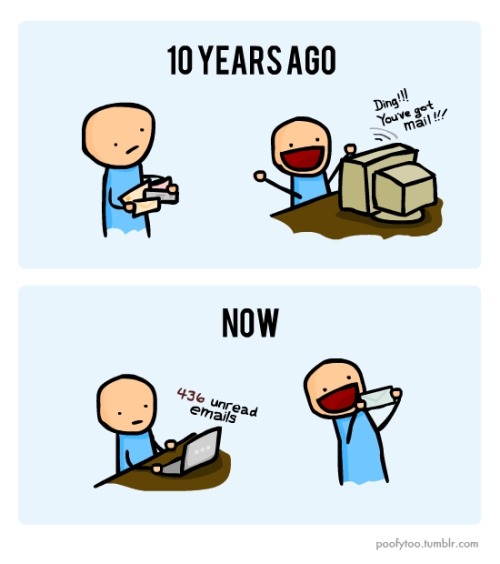
This cartoon has been making the rounds on the internet. Various friends of mine and the Oxford English Dictionary, among many, many others, have posted it on their Facebook pages.
[original here]
Yeah. Exactly.


III.
At what point is a trend a trend? It's tempting to see an article about a topic you've been thinking about, or overhear a conversation about a thing that you yourself did just yesterday, and to conclude, ergo, I AM AT THE CUTTING EDGE OF A NEW AND POPULAR THING! This magazine story includes a recipe for molasses cookies! And that guy at the store had a bottle of molasses in his cart! And I ate a molasses cookie for breakfast last week! That's three data points! Quick, someone set up a Tumblr and call the Times and get a trend piece in the Sunday paper! 

So I'm wary of drawing too many conclusions from my own biased, myopic observations. Nonetheless. There's something going on, the data points are widespread--the random people who write to me from the Netherlands and Bangladesh and Brazil (many of them young, I might add, lest you think this is just a nostalgic older-person thing) and the OED staffers and the esteemed New Yorker writers (hello, Roger Angell)--they're all over the place, people talking about letters and what a joy it is to send them and receive them.

Maybe it's a literary thing, specific to the bookish types whose days begin with Michiko Kakutani at the breakfast table and end with Gary Shteyngart in bed (... wait, that's not what I meant). People who love books, it follows, have specific romantic, wistful fixations on the printed word, and are probably--okay, damn near certainly--more inclined to hunger for handwritten letters, and to write them. There's certainly a common literary thread here.

Like: the publishing industry blog GalleyCat reported a few days ago that author Mary Robinette Kowal is launching what she calls The Month of Letters Challenge--starting today, she and anyone else who joins the cause will send at least one piece of Real Mail every day the US Postal Service is in operation in February.

Like: The Rumpus, that proudly idiosyncratic online magazine of culture--particularly the literary variety--has taken the nascent trend and run with it, in their own way. They're calling it Letters in the Mail. Five bucks a month gets you one every week or so.
Letter writers will include Dave Eggers, Tao Lin, Stephen Elliott, Janet Fitch, Nick Flynn, Margaret Cho, Cheryl Strayed, Marc Maron, Elissa Schappel, Wendy MacNaughton, Emily Gould, and Jonathan Ames. Think of it as the letters you used to get from your creative friends, before this whole internet/email thing.
The lede from BookRiot's story on Letters in the Mail: "What's the next arena for literary foment? Try your mailbox."

But even if there is that bookish tinge to all of this, even if the most obvious data points come from this specific area of culture of which I am a more than part-time inhabitant, those data points, in the aggregate, arguably add up to something bigger, something more widespread. I fully support letters being the next arena of literary foment, but the more important thing is that they be more than just that.

IV.
Dave Eggers. Of course Dave Eggers is on that list--of course he's at the top of that list. Because, with all due respect, Mr. Eggers's very name has become a synonym for a certain aggressively earnest, calculatedly quirky, and--let's just say it--oft-grating flavor of modern culture. It's not that he isn't a brilliant writer (he is) and innovative publisher (ditto), it's that there's something uniquely maddening about Eggers-style culture, precisely because it wants to be so good for you, combining intellect with self-aware whimsy and then hard-selling it to you as a product, arch preciousness as packaged good. 

And that's what kind of frightens me about the nascent rebirth of letters: I don't want this to be about nostalgia and wistfulness, alluring as they may be. I don't want this to be about affecting a specific pose, washed down with your neighbor's homemade craft absinthe to a retro-melancholy soundtrack of an intentionally-scratched EP by next year's South By Southwest darlings. 

Letter-writing is about specific personal connection. That's the allure. I don't care if your envelope is made from a "Dukes of Hazzard" poster and the letter is about your inspiring corndog lunch with Rick Santorum. If you took the time to put pen to paper and shelled out forty-five of your hard-earned cents for a stamp, and made the effort to find a mailbox, I really do appreciate it. (Anthrax and epithets excluded, of course. Just to be clear.)

V.
My girlfriend and I met on the internet but fell in love over letters. Handwritten, sometimes handmade, old-school letters. Even though we lived in the same city and saw each other in person all the time, we sent letters (still do--Maren, check your mailbox). Sometimes we go for walks and one of us will say, "Oh, we have to stop by a mailbox so I can send this letter to you." 

VI. 
Is it just nostalgia? Is that why I like to write letters? Is that why other people are writing letters? 

VII.
In part. Maybe. But I don't think so. And I sure as hell hope not because to a large degree, nostalgia is a wistful appreciation of something lost forever--it's a sequestering of that place or thing into the realm of memory, not present-day reality. It becomes self-pity: I wish I were alive in that time, doing that thing. But as, oh, everyone who has commented on nostalgia has pointed out, it paints a pretty picture, but not at all an accurate one. (I like modern medicine, I like not living in a time when state governors literally stand in the way of desegregation.)

My parents also wrote letters to each other in their courting days. My mother did a European Grand Tour for ten weeks in 1967 while my father stayed behind finishing up architecture school in Minneapolis, and the two sent letters to each other every two or three days. They've kept every last scrap of paper--letters, postcards, aerograms--in shoeboxes (literally, shoeboxes) for the last forty-plus years. (For anyone new here: this blog started as a means for me to document my own journey in my mom's footsteps, using those letters. Read all about it in my book coming out in April!)

As much as I'd like to pretend that everything my parents wrote to each other was dramatic and intriguing and elegantly-phrased (and written in quill-and-ink, on fine vellum), the truth is that much of it just isn't particularly interesting or quotable. They had a shocking disregard for the narrative-enhancing needs of the son they would have fourteen years later and who would grow up to be a writer. They wrote pages and pages to each other, but much of it was like this, from a letter Dad wrote to Mom in Vienna:
 Gee whiz, Sil [they both called each other “Silly,” or, shortened, “Sil”], nothing out of the ordinary has been going on for the last couple of days. I know you've heard that all to [sic] often, which would sound like life is dull, which it is not at all. In fact, it is not even really routine. But the little things which make life interesting and wonderful seem trivial when repeated without the benefit of all the background. Let me see. What was my point. Oh, yes. In spite of its seeming—and necessary—sameness of school, work, and study it is not. I hope you follow, because compared to three months of travel this type of life could seem totally worthless, which it is not. Or maybe dull is a better word, which it still is not."
Or, just picking another letter sent to Vienna, there's this text-message-like note from Mom's sister, Susan, then a student at the University of Miami (all punctuation and spelling are hers):
speaking of the other u of m and homecomings and all that, yours was last weekend, and your friend and mine . . . yes, you know who, called . . . he was lonely for you . . . boy, was i sad for him . . . you wicked thing, what are you doing running around europe while he's playing solitaire on homecoming night? (don't you feel mean?) . . . anyway, i was really glad to talk to him, 'cause that was right when the plague was setting into me 
Even more than travel or love, Mom and Dad wrote about the mundane minutiae of the day-to-day: missing library books, enrolling for classes, Dad's impending Air Force enlistment, a bus strike in Minneapolis, and Dad's current projects in architecture school. Much of the content was, quite frankly, precisely like today's Facebook status updates: comments on the latest local news, who went to what party last night, who ate what for lunch. The foundations of everyday life but not much of broader intrigue.

VIII.
No, it's not the content of our communication that has changed. It's the audience and the immediacy.

A postcard or a letter goes to one person—maybe a household, at most. It can't be forwarded with the click of a button. It can't be read in an RSS feed or on a mobile device by the whole world. 

Writing to my father in 1967, my mother often drew little flowers next to her name or added additional comments along the side of a card. She sketched sheep and churches. Her handwriting was shaky when she was on a bus, large and loopy when she was trying to express a particularly important idea (usually, “I LOVE YOU”). She wrote on postcards, on wine labels, on tickets, on paper bags, on toilet paper. Dad wrote on aerograms (those sheets that fold into envelopes; here is an aerogram template for you), on a long piece of drafting paper, on stationery from work. He sketched, too, including one card sent at the end of Mom's trip, with a forlorn Charlie Brown lookalike “welCOME BACK.” There was no concern for a catchy subject line. There were no links or embedded videos to pull the reader away. There were no ads on the side begging to clicked or pop-up chat boxes with salutations from bored friends-of-friends. It was not intended for a broad audience; it couldn't easily be cut and pasted or forwarded on to someone else. It was personal, the doodles and handwriting and surfaces providing an intimacy that blogs and e-mails simply cannot; it's the difference between dancing and lockstep marching or, more aptly, between a human and a machine. 

IX.
The key, as I said, is a specific personal connection--and that's something that (I sure hope) knows no era and has no concern for trend. That's why my girlfriend, Maren, and I send letters to each other even though we see each other nearly every day--because it's a physical reminder of each other and our thoughts and our stories, a piece of ourselves that we can pin to a cork board or place on our shelves. It's a small handcrafted good that says, "When you weren't around, I was still thinking of you--and I made this for you."

It's the knowledge--or at least the presumption--that this particular person has written this particular thing to you. There's an implied intimacy there that can never be articulated in emails precisely because it is unspoken--it's about the act as much as the content. The effort and literal expense (money-wise but also time-wise) of sending a letter make a world of difference. This physical item was in the other person's possession, and now it is yours. There's a transfer of ownership--a gift of sorts, a memento. (I have a rather hard time imagining my mother saying, “Oh, just open my e-mail and do a search for the dates September through December 1967 and then read our notes!”)

Tactile, three-dimensional objects--especially letters, as manifestations of our ideas and personality and voice, captured in our unique scrawling writing--will, I respectfully submit, always be more ineffably soul-stirring than their pixelated, code-created counterparts. 

X.
I want my own kids--whenever I have them, and no matter how digital the world has become by the time they grow up--to understand that, to agree. And to dance through through their own hallways on those frequent occasions when they receive a handwritten letter. 

---
Notes: 
1. If you send me a letter or postcard, I promise I will (a) do that happy mail-nerd dance when I get it, and (b) write back. My address is over there in the side-bar at right.

2. Many thanks to the various friends who have forwarded me the mail-related stories referenced in this post. Cheers, John Neely, Pam Mandel, Eva Holland, and Jason Albert. 

3. N.B.: I make these points better, faster, and with more storytelling and less pontificating in the book.

12 December 2011

Postcard Gallery: Bangladesh, New Zealand, epic four-page letter

Forgive me, Postcard Gallery--I have neglected you too long. But even though I'm a slacker, my mailbox runneth over. Highlights include a homemade postcard from Bangladesh, a note from an actual postcard archivist (!), and a four-page masterpiece of a letter, written in dip pen and featuring a half-page illustration. It's glorious. Click on the images for higher resolution.

From Renee in Bangladesh (who took the photo on the front):

Yes, this is the first postcard I've received from Bangladesh. Thanks, Renee!
From Eva Holland way up in the Yukon, where it's been snowing since, like, August:

The "historic Minneapolis train bridge" is the Stone Arch Bridge, one of
my favorite spots in the city.
From Debra Gust at the Curt Teich Postcard Archives, which is apparently a real thing and which I must visit at once, at the Lake County Discovery Museum:


From ... I honestly don't know who, other than someone channeling Garrison Keillor while driving through Saint Peter, Minnesota (although the picture is of Denmark):


From Jane in New Zealand (who also sent me that delightful bear-o-gram a while back; the bear has settled in among the travel books on my shelves and seems quite content, although it does occasionally commandeer my computer to look up the latest news about the All-Blacks):


And, finally, the letter. Now, let me introduce this by saying that I get giddy every time I see a piece of paper in my mailbox. Few things (chocolate croissants, for example) make me happier than getting a postcard or a letter, even from people I know (hi, Mom!). But. There is still something particularly wonderful about getting mail from absolute strangers, especially when they've clearly gone above and beyond in the effort. Every now and then, I get a letter that makes me not just smile but do a little jig right here in the post office--or, in this case, basically sprint outside and do a triumphant, sprinting lap around the building.

Brendon Ly is, I hereby decree, the coolest 15-year-old in Ottawa. He's the one who sent me the postcard from there a few weeks ago, the one beginning, "Hello, Stranger." When I opened his latest letter, this was the first thing I saw:

Crappy picture on my part, but you get the idea.
An authentic, mint-condition vintage air-mail envelope. Unused. Just ... for me to add to my collection (or, you know, send to someone). And then there was this:

A four-page letter. In old-style script writing. (Note at the top of the first page: "Pre-script: Usually I print.") Needless to say, no e-mail could possibly convey the same sense of personality and, well, charm as this letter, and even a high-resolution scan can't capture its nuances and details. Like the ink. As he notes on page three, "By the way, if you run a finger over the words, they will have a raised texture to them. I think this Chinese ink has shellac in it ... The thickness added by the shellac also helps it cling to dip pens, but will apparently clog up a fountain pen." Sure enough: it's raised. (NB: I had no idea fountain pens and dip pens were not the same thing. When I read that, I wanted to click over to Google to do some quick research--ignoring the rest of the letter for a sec, as I would have if it were an e-mail, only to return to it half an hour later after getting hopelessly distracted--but, this being a letter, I couldn't just move my mouse a few inches and click away. I couldn't be distracted. Score one more point for letters: they're more immersive.)


That blue pen you see above is a calligraphy pen, just to show off the differences in texture and stroke and style.

Finally, on the last page, the show-stopper. A hand-drawn illustration perfectly sized to make into a postcard. Included in the envelope was a piece of card stock with a the back already formatted.


"You know the rest," he says. "Send it to whomever you want to."

In other words, continue the cycle. Keep it going. Keep writing. Keep sharing. Not in the easy, mindless digital form--"sharing is caring," says all the 18-point Arial above a row of icons for FaceTwitPlusWhateverElseWasInventedYesterday. But in the more tangible, more physical, more personal sense. More texture, quite literally.

What a joy to get this letter--any letter, any postcard, of course, but especially this one.

And, yes, I will send the postcard on to someone else. Part of me wants to keep it for myself and not take scissors to paper. But that would defeat the entire point. A tear will trickle down my cheek as I release it into the mailbox, just like in those Disney films, the ones with the whales or the lions or the what-have-yous, and the benevolent caretakers who know the animals must be returned to the wild. Go free, young postcard! Venture forth! Godspeed! Find your place in the world! 

Keep writing.

So. Thanks, correspondents! Much appreciated. My own stamp-affixed messages are already en route in some cases; the rest will be on the way in the next day or two--although, Brendon, it might take me a bit longer to come up with something to match your awesomeness.

14 November 2011

The Authoritative Guide to Being an Expert Tourist (vol. 1)


Congratulations on advancing this far, young tourist. You've done well.

You have mastered the Security Line Rumba, that dance of slipping off your shoes and emptying your pockets while pirouetting to avoid the trio of hungover conventioneers whacking you with their carry-ons as they try to dig out their laptops.

Your internal Irish Pub radar is so well-honed that you can smell the Guinness and County Cork tchotchkes from three miles away.

You have perfected the Goofy Tourist Picture Pose, every bit as ridiculous and labored as a supermodel's pout-strut, but accessorized so much more creatively, with the Eiffel Tower as a hat or Manneken Pis pee(r)ing over your shoulder or Mary Tyler Moore as your bronzed arm-candy (see fig. 1). (See further reading section below.)

Fig. 1
But those were just the basics. You have proven your interest and commitment. Now you must prove yourself. It is time to move on to the Advanced Touristing Techniques. And I, your Touristing Guru Master Expert Dude, am here to help. Master just a few more skills, young camera-toting, globe-trotting, guidebook-waving grasshopper, and you, too, will be able to call yourself a true Advanced Expert Tourist.

This will be an ongoing set of lessons--the wisdom of the ancients cannot be explained in a single blog post, nor can true proficiency be attained if your focus is not pure and constant. I ask--nay, implore--you to begin practicing forthwith and to dedicate yourself to the cause with singular vigor. More lessons will follow shortly.

TODAY'S LESSON:

Get out of the way or join the dance: Two methods of interacting with other camera-toting tourists.

Method 1: The camera-duck/tourist-pivot
The scenario: You're walking through a busy tourist area and you spot someone seemingly staring--hard--into space, a big, cheesy grin affixed to his or her face.

Rookie mistake: After staring hard at the person, trying to determine what that demented Jack Nicholson-in-The Shining grin is all about (and whether or not you should be sprinting away), you realize that said person is posing for a picture. You stop abruptly so as not to walk into the frame, but your halting, flustered demeanor makes the poser and the photographer both become self-conscious, and the poser starts to apologize just as the camera shutter clicks, necessitating a do-over or ten. The spontaneity is lost, the moment ruined, and it's all your fault.

Advanced technique: After much time on the tourist trail and much practice spotting the assorted and multitudinous but not-very-elusive breeds of photo-posers, you will hone your vision and instinct and be able to spot them from a minimum of twenty strides away. Pretend you don't see them but stay out of the frame. Don't break stride, don't make eye contact, just duck or pivot around them.

Recommended practice: Ducking and/or pivoting without breaking stride. I suggest at least five reps of ten pivots and fifteen walking-ducks per day.